
In this research, we use mathematical models to predict how micro-scale interactions and phenotypic heterogeneity shape global hierarchical dynamics of microbial ecosystems. We aim to identify fundamental principles governing transient and asymptotic patterns of competitive exclusion, coexistence or multi-stability. We develop new analytical and computational frameworks based on separation of timescales, to link neutral and non-neutral dynamics, with a special focus on multi-strain infectious disease ecology (Gjini and Madec ,2017) (Madec and Gjini, 2019), (Gjini & Madec 2020)
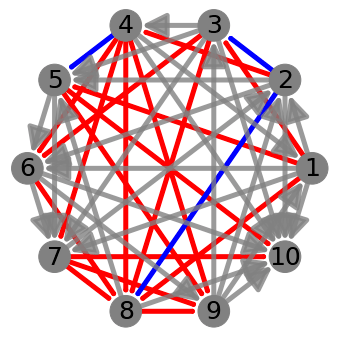
Multiple bacterial strains interacting upon co-colonization generate complex N-dimensional frequency dynamics captured by the replicator equation. These dynamics can be expressed explicitly in terms of their pairwise invasion fitness network (red: coexistence; blue: bistability; gray: competitive exclusion)
Streptococcus pneumoniae polymorphic bacteria, with large antigenic diversity (>90 serotypes), are an important case in the topic. Although generally carried asymptomatically in the human nasopharynx, they are a major cause of morbidity and mortality in young children worldwide. Much research is currently devoted to understanding the interactions between different pneumococcal serotypes and clonal variants, and the implications of such competitive underpinning for vaccination effects, antibiotic resistance dynamics and public health interventions. Using dynamic models of colonization and co-colonization by S.pneumoniae, and integrating them with cross-sectional prevalence data across time and space, we can estimate the magnitude of serotype interactions (Gjini et al., 2016), quantify vaccine protection parameters and their variation (Gjini, 2017), and test ecological hypotheses on global patterns (Dekaj and Gjini, 2024).
Related works:
- Gjini E. and Madec S. (2023) Towards a mathematical understanding of invasion resistance in multispecies communities Royal Society Open Science, https://doi.org/10.1098/rsos.231034
- Le T.M.T., Gjini E. and Madec S. (2023) Quasi-neutral Dynamics in a Coinfection System with N Strains and Asymmetries along Multiple Traits, Journal of Mathematical Biology, Volume 87, number 48, doi: 10.1007/s00285-023-01977-7
- Dimas Martins A. and Gjini E. (2020) Modeling competitive mixtures with the Lotka-Volterra framework for more complex fitness assessment between strains Frontiers in Microbiology | doi: 10.3389/fmicb.2020.572487
 Erida Gjini